The platform tracks over 9,200 active interconnection queue projects from the LBNL National Interconnection Queue Database and 7 ISO/RTO live feeds. Each project has a dedicated detail page showing queue status, interconnection timeline, county-level location, technology breakdown, and related news.
What are interconnection queues?
Before a new power plant can connect to the grid, the developer must apply to the regional ISO/RTO for an interconnection agreement. The queue is the ordered list of pending applications. Queue position, study phase, and time-in-queue are leading indicators of whether a project will reach commercial operation — and when.
The platform covers 7 ISO/RTO queues: CAISO, ERCOT, MISO, PJM, NYISO, ISO-NE, and SPP — plus additional entities tracked through the LBNL database (BPA, PacifiCorp, SOCO, and others). Combined, this covers 38,000+ total queue entries, of which ~9,300 are active or suspended.
Data sources
LBNL National Interconnection Queue Database
Maintained by Lawrence Berkeley National Laboratory. Provides a standardized baseline across all US interconnection queues — project name, capacity, technology, state, county, queue date, IA status, and proposed COD. Updated quarterly.
ISO/RTO live queue feeds
Direct feeds from CAISO, ERCOT, MISO, PJM, NYISO, ISO-NE, and SPP interconnection queue portals. These provide ISO-specific fields not in LBNL: detailed study phase, service type (ERIS vs NRIS), status detail, and developer information. Live feeds are merged with LBNL data by queue ID.
Queue lifecycle
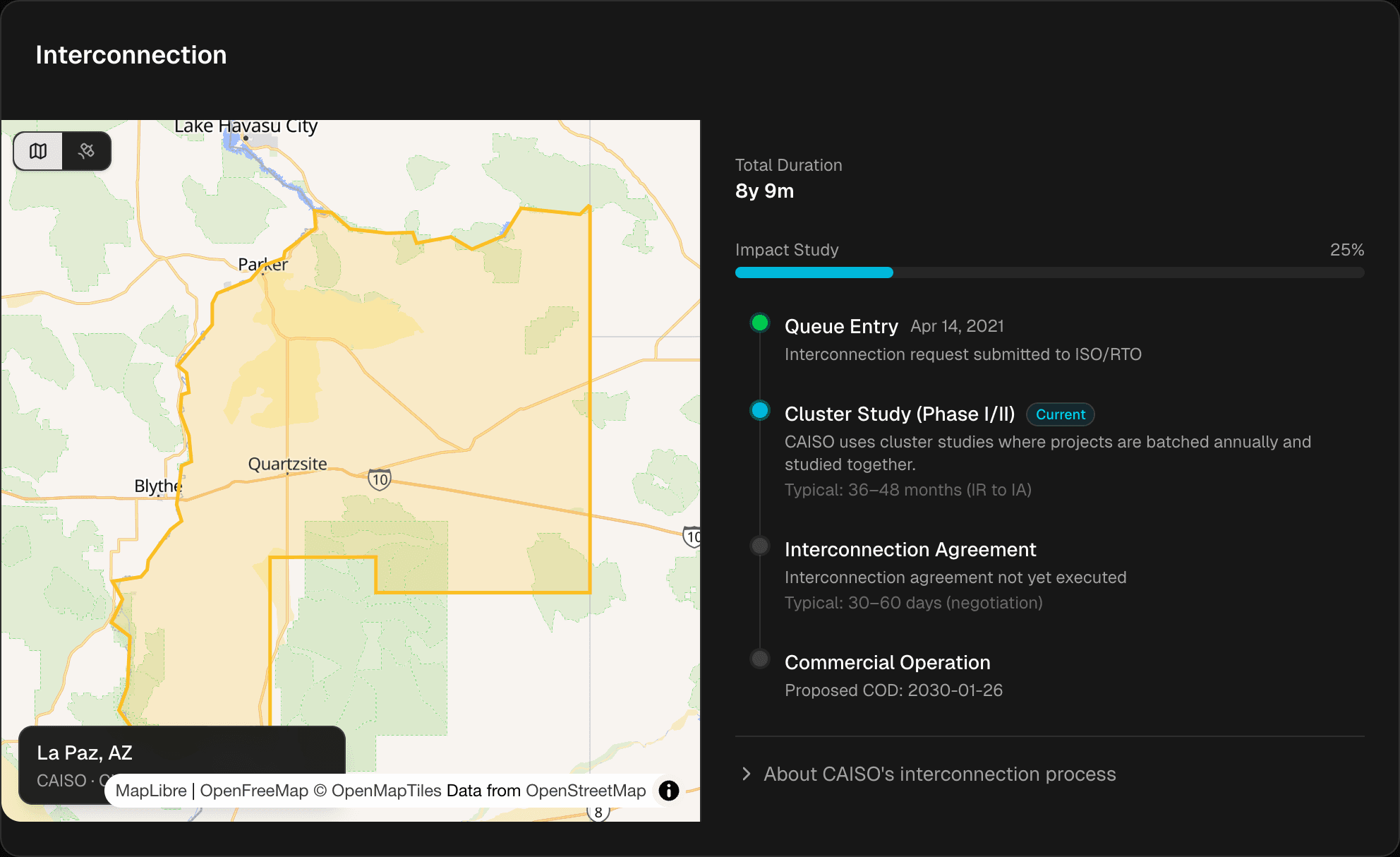
A project moves through several phases from application to commercial operation. The interconnection timeline on each project page visualizes this progression:
Queue Entry
The developer submits an interconnection request to the ISO/RTO. The queue date marks entry.
Study Phases
System impact studies, facility studies, or cluster studies (depending on the ISO). These determine what grid upgrades are needed and their cost. This is typically the longest phase — 36 to 48 months on average.
Interconnection Agreement
The developer and transmission provider execute a binding interconnection agreement. The project now has a defined path to grid connection.
Commercial Operation
The plant begins generating electricity and selling to the grid. The proposed COD date from the queue application is shown on the timeline.
ISO-specific context
Different ISOs run different interconnection processes. CAISO uses annual cluster studies. MISO uses a definitive planning phase model. PJM recently reformed its queue with a first-ready, first-served approach. The platform captures these differences in ISO-specific metadata fields:
| Field | Description | Example |
|---|---|---|
| Study Phase | Current phase in the interconnection study process | System Impact Study |
| Service Type | ERIS (Energy Resource) or NRIS (Network Resource) | ERIS |
| Status Detail | ISO-specific status description beyond Active/Withdrawn | Cluster Study (Phase I/II) |
| IA Status | Interconnection agreement execution status | System Impact Study |
Entity resolution
Queue projects are matched to operating EIA plants using a name-weighted 6-signal matching algorithm (project name, capacity, technology, county, state, coordinates). When a high-confidence match is found, the project page links directly to the corresponding plant page. This connects the development pipeline to the operating fleet.
Coverage
| ISO/RTO | Total Queue Entries | Active Projects |
|---|---|---|
| PJM | 8,600 | ~2,500 |
| MISO | 5,301 | ~1,500 |
| ERCOT | 3,679 | ~1,200 |
| SPP | 2,853 | ~800 |
| CAISO | 2,833 | ~900 |
| NYISO | 1,845 | ~600 |
| ISO-NE | 1,263 | ~400 |
| Others (LBNL) | 11,669 | ~1,300 |
Total: 38,043 queue entries across all sources, of which 9,783 are active or suspended.
Project pages
Every queue project has a dedicated detail page at /project/[slug]. These are distinct from plant pages — they show queue lifecycle data, county-level geographic context, and the development timeline rather than operating performance.
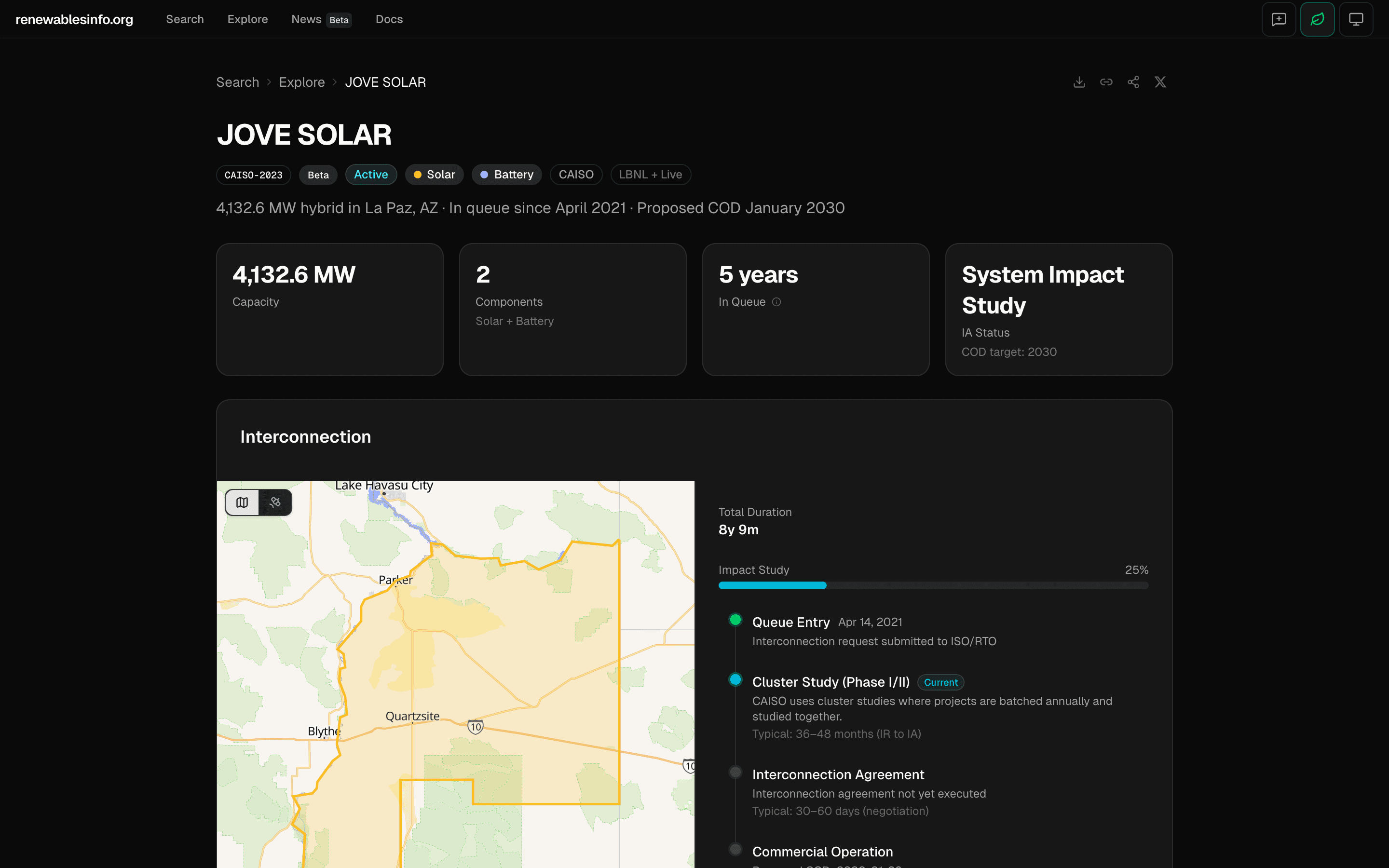
Each project page includes: hero with status and technology badges, KPI cards (capacity, components, time in queue, IA status), a combined county boundary map + interconnection timeline section, technology breakdown for hybrid projects, project details (developer, utility, POI, service type), and news articles.
County boundary map
The map highlights the project's county with an amber polygon overlay, showing surrounding county and state boundaries for geographic context. The amber color is intentionally distinct from the blue used on plant pages (which have precise lat/lon) — it communicates "this project is in this county" rather than implying a specific site location. 93% of projects have county data; projects without it show the timeline at full width.
EIA plant match
When a high-confidence match exists between a queue project and an operating EIA plant, a link connects the two. This bridges the development pipeline with the operational fleet — a project that has been built and is now operating links to its plant page with full generation, financial, and ownership data.
How project pages differ from plant pages
| Aspect | Plant Page | Project Page |
|---|---|---|
| Location | Precise lat/lon with map marker | County-level with boundary polygon |
| Status | Operating, Retired, Standby, etc. | Active, Suspended, Withdrawn + IA status |
| Engineering | Per-generator specs (USPVDB, USWTDB) | Technology breakdown by component type |
| Timeline | Operating year + retirement date | Full interconnection lifecycle |
| Financial | FERC, LBNL, EQR data | Not yet available |
| Generation | Monthly MWh time series | Not applicable (pre-operational) |