Every plant in the database has a dedicated detail page with 12 data sections. Each section draws from different sources and shows a distinct dimension of the plant — from basic identification to financial metrics to recent news. This page explains what each section contains and where the data comes from.
View example: Palo Verde Nuclear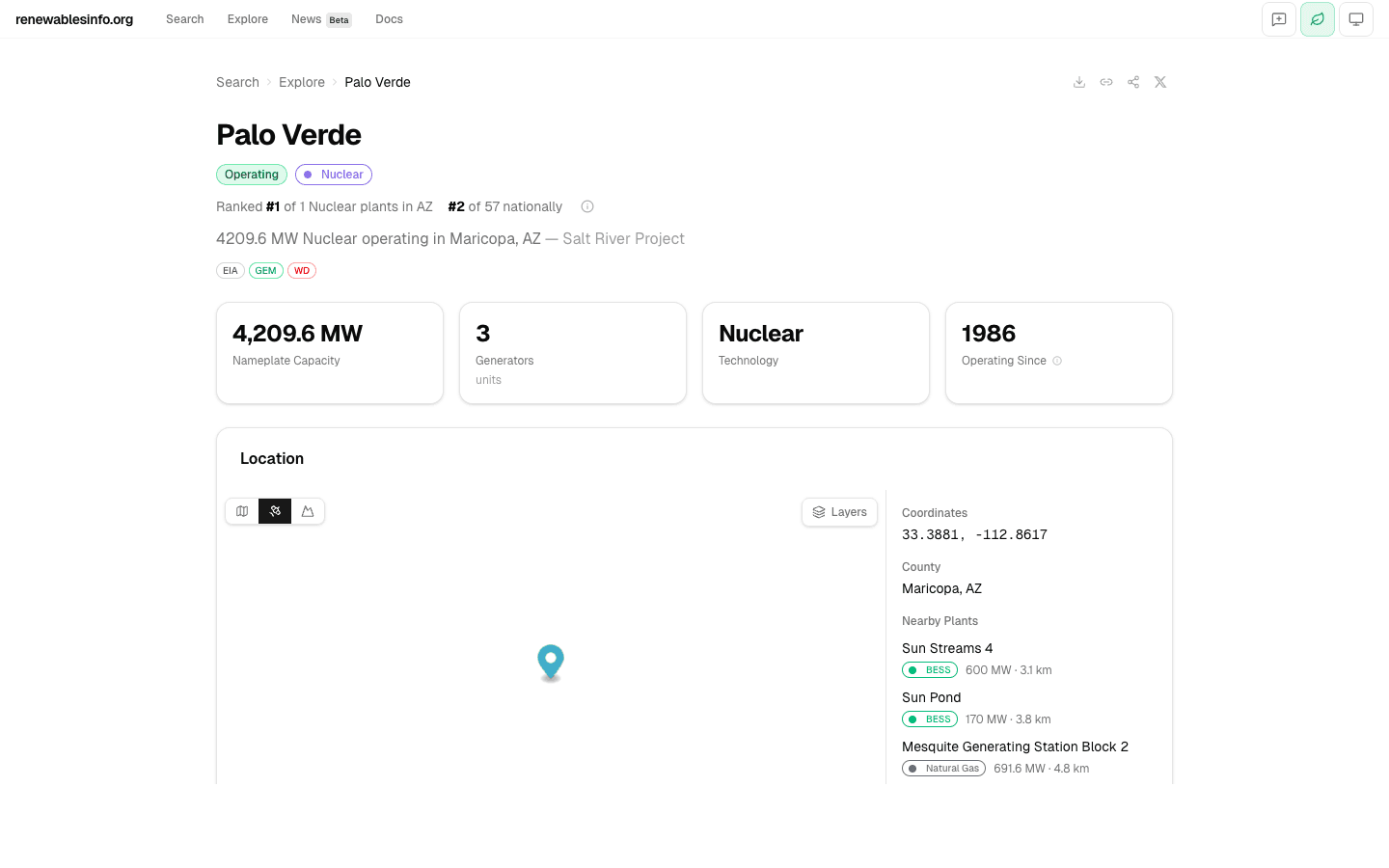
Hero
The top of every plant page shows the plant name, a color-coded fuel type badge, the operating status (Operating, Standby, Retired, etc.), and the location (state and county). The fuel type badge uses the platform's standard color system — consistent across the search page, explore map, and plant detail.
KPI Cards
A row of key performance indicators giving immediate context: total nameplate capacity (MW), number of generators, the year the plant began operating, and the latest annual capacity factor (when generation data is available). State and national rankings are shown — for example, "3rd largest solar plant in Texas" or "12th in the US." Rankings are computed at export time against the actual dataset, not estimates.
Map
An interactive MapLibre map centered on the plant's coordinates. When an OpenStreetMap boundary polygon is available, it is rendered as a shaded overlay showing the plant's physical footprint. The map is fully open source with no API key — no Mapbox dependency, no usage limits.
Ownership
Three layers of ownership information. The EIA-registered utility or operator (from Form 860). The GEM-identified parent company. And the ownership chain — a tree showing subsidiary → parent → ultimate parent relationships, resolved through GEM entity data. When EIA and GEM disagree on the owner name (common with SPV structures), both names are shown and the discrepancy is flagged.
About
Plant description and identification data. When a Wikipedia article exists (linked via Wikidata Q-ID), the opening paragraphs are displayed as a human-readable summary. Below that: the EIA Plant ID, Wikidata Q-ID, sector classification, NERC region, and links to external databases (EIA, Wikidata, OpenStreetMap, PUDL).
Engineering
Generator-level specifications. Every generator at the plant is listed with its nameplate capacity, prime mover type, fuel source, and online year. For solar generators with USPVDB matches: panel area, tracking type (fixed, single-axis, dual-axis), and DC/AC ratio. For wind generators with USWTDB matches: hub height, rotor diameter, total height, manufacturer, and turbine model. For battery storage: storage capacity in MWh.
Simple plants (single generator, single technology) show a compact card. Complex plants with dozens of generators show a summary with an expandable accordion. Hybrid plants with multiple fuel types use tabs to separate technologies.
Grid Context
Where the plant sits in the electrical grid: balancing authority, ISO/RTO region (CAISO, ERCOT, MISO, PJM, NYISO, ISO-NE, SPP, or non-ISO), and transmission owner. This context is essential for understanding which market the plant operates in and which pricing signals apply to it.
Generation
Monthly net generation time series from the EIA Generation API. Shown as an interactive chart with monthly MWh values. Derived metrics include: annual capacity factor, 12-month rolling capacity factor, and annual generation totals. The chart reveals seasonal patterns (solar peaks in summer, wind varies by region) and long-term trends.
Financial (Beta)
Financial data from up to three sources, when available. FERC Form 1 provides capital and operating costs for regulated utilities (~1,400 plants). LBNL provides installed cost and PPA prices for utility-scale solar projects. FERC EQR provides energy contract data — seller name, buyer name, contract price, and volume. Each data point is attributed to its source with a badge.
Pricing
Nearby ISO pricing nodes with distance from the plant, node type (generation, load, hub, zone), and ISO assignment. Covers seven ISOs: CAISO, ERCOT, MISO, PJM, NYISO, ISO-NE, and SPP. Node crosswalks are built from EIA plant data, OpenStreetMap substation data, and curated node databases.
News (Beta)
Up to 4 recent news articles mentioning the plant, sourced from Google News and classified by LLM into categories (deals, hazards, regulatory, grid, industry) with named entity extraction. Each article shows a category badge, entity pills, source, and date. Category filter pills appear when articles span multiple categories. A "View all articles" link opens the full news hub filtered to that plant. Covers plants with 10 MW or greater capacity. See the News docs for full details.
Discovery
Links to related plants and external resources. Similar plants (same fuel type, comparable capacity in the same state). Nearby plants (geographically close regardless of fuel type). External database links to EIA, Wikidata, OpenStreetMap, and PUDL when identifiers are available. This section exists to support exploration — finding connections the user did not arrive looking for.